
AI Shopping Agents Can Buy Auto Parts Now. Can They Tell What Fits?
AI agents can now search Shopify stores and check out for the buyer. For auto parts, they can only pick the right part if your fitment data says, in plain words, which car it fits.
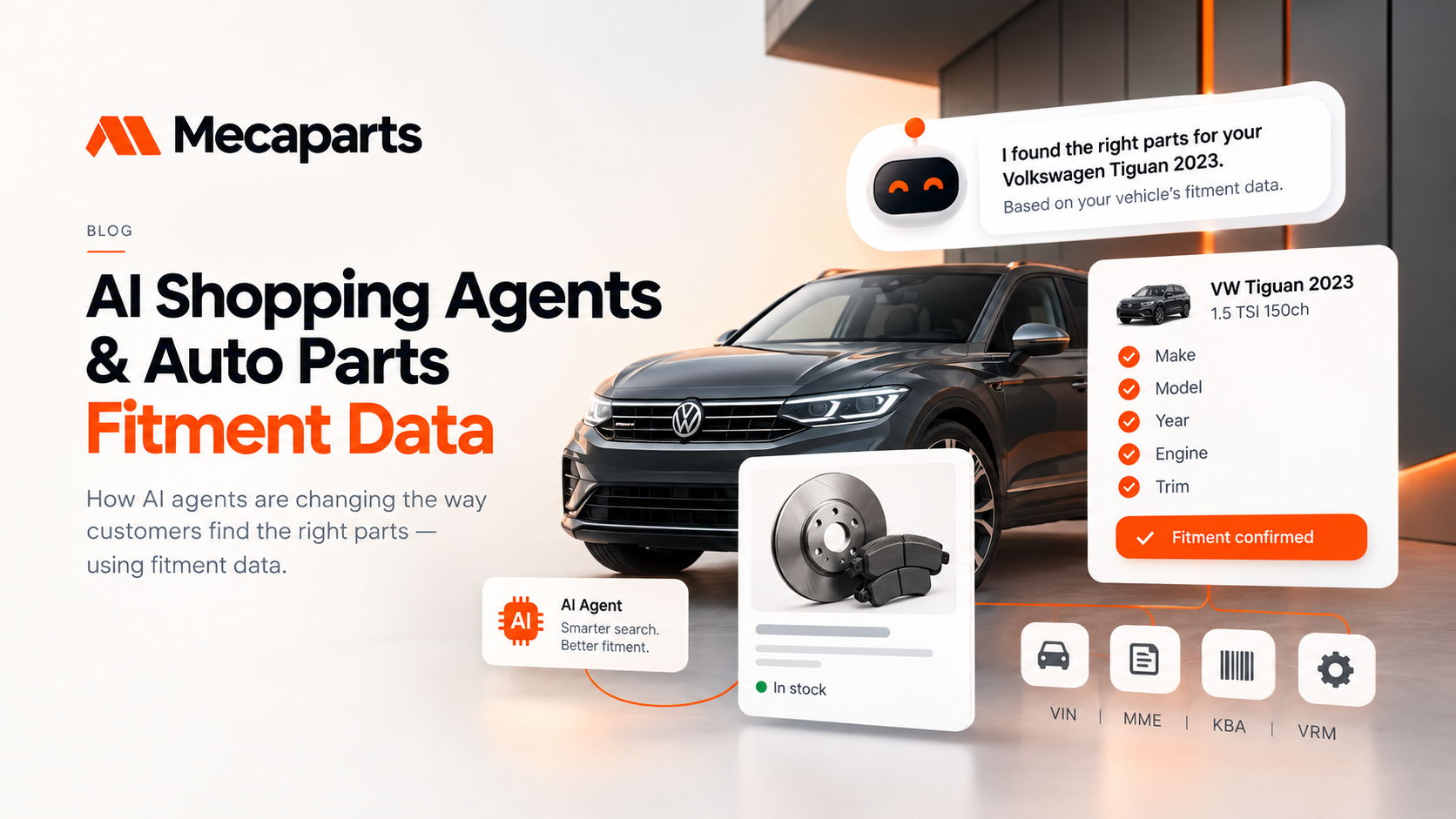
A driver types into an AI assistant: "Order front brake pads for my 2014 Golf 1.6 TDI, delivered by Friday." Until recently, the assistant could suggest products and send a link. Now it can finish the job. On 28 September 2026, Shopify launched checkout support, including Shop Pay, for browser-based AI agents on all eligible Shopify stores (TechCrunch). In October it followed with a skill that turns any AI agent into a personal shopper connected to the buyer's Shop account (Shopifreaks).
For most product categories, that is a new sales channel. For auto parts, it is also a new risk. An agent cannot look at the car. It can only read what your product data says. If your listing says "universal" or "fits Golf", the agent either skips you or buys the wrong part on the customer's behalf. Fitment data is now what decides whether software can sell your parts at all.
What changed in the last few weeks
January 2026: Google and Shopify launched the Universal Commerce Protocol (UCP), an open standard for AI agents to handle the buying journey from research to after-sales (Shopifreaks).
28 September 2026: agents working inside the buyer's browser can now read, update and complete a Shopify checkout, with the buyer's authorisation.
October 2026: a Shop skill lets agents search Shopify Catalog, which covers more than a billion products, read the buyer's past orders and check out with Shop Pay. By default the buyer approves each purchase.
None of this is specific to car parts. That is the point. The same agent that buys a T-shirt will try to buy a brake disc, using the same logic: match the request to the product data it can read.
Why auto parts are the hard case for agents
A T-shirt has a size. A brake pad has a vehicle. The same model name can hide several generations, facelifts, engine codes and brake systems. A request like "pads for a 2014 Golf 1.6 TDI" is only answerable if the product carries a clear link to that exact variant, or a part number the agent can check.
Three listing habits fail here:
"Universal fit" or "fits most cars": nothing for an agent to verify.
Fitment hidden in an image or a PDF: not readable as text.
Model name only, no engine or years: ambiguous, so the agent has to guess.
The cost of an agent ordering the wrong part
When a person buys the wrong part, they at least chose it. When an agent buys it, the customer blames the store. You still pay for two shipments, handling and the support conversation, and you lose a customer who may tell their assistant to avoid you next time.
The upside is just as real. A store whose pages state exactly which vehicles a part fits gives an agent a confident answer. Clear data is the difference between being the store the agent recommends and the store it ignores.
What an agent needs to read on a parts page
Think of the product page as an answer sheet for software. It should state, in text:
Part type, brand and manufacturer part number in the title.
The list of compatible vehicles: make, model, engine, power and production years.
OE and cross-reference numbers, so the agent can match a number the buyer already has.
Key specifications such as diameter, thickness or position (front or rear axle).
Real stock, delivery time and a clear returns policy.
Six things to do this week
Check in your Shopify admin whether your store is shared with Shopify Catalog and whether Shop Pay is active.
Search your catalogue for "universal" and "fits most". Replace each with a real vehicle list or remove the claim.
Rewrite the titles of your 50 best sellers: part type, brand, part number, axle or position.
Move fitment out of images and PDFs into page text.
Ask two or three AI assistants for a specific part for a specific car. Note whether your store appears and what the assistant says about fit.
Make your returns policy and delivery times plain text on every product page, not only in the footer.
Doing it with Shopify, TecDoc and Mecaparts
Writing vehicle lists by hand for thousands of parts is not realistic. TecDoc, the catalogue standard from TecAlliance, already links parts to vehicle variants (KType) and to OE numbers. Mecaparts connects your own TecDoc licence to your Shopify store and puts that data where buyers, and the agents shopping for them, can read it:
The list of compatible vehicles and OE and cross-reference numbers on every product page, plus a "fits / doesn't fit" badge once a vehicle is selected.
Vehicle search by make, model and engine, VIN search when your TecDoc subscription includes VIN lookup, and KBA (HSN/TSN) as an add-on.
Bulk import from CSV or Excel or direct selection in TecDoc, rule-based categories, and price and stock sync so availability stays accurate.
Storefronts in English, French, German, Spanish, Italian and Norwegian.
Mecaparts does not resell TecDoc data. Learn more about TecDoc on Shopify or compare the options.
FAQs
Do I have to do anything for AI agents to reach my Shopify store?
Shopify is rolling agent checkout out to eligible stores. Check your Shopify Catalog and Shop Pay settings in the admin, and make sure your product data is complete. That part is entirely in your hands.
Will an agent buy without the customer's approval?
According to the reporting on Shopify's launches, checkout happens with the buyer's authorisation, and in the Shop skill the buyer approves each purchase by default. Buyers can also set rules such as a budget.
Is this only relevant for B2C stores?
No. Clear fitment and OE numbers help garages ordering in a hurry as much as they help agents. The same data serves every channel.
AI agents will not guess for you. They reward the stores that state fitment clearly. If you sell on Shopify and hold a TecDoc licence, you can show the compatible vehicles and OE numbers on every product page. Start the 3-day free trial.
TecDoc is a registered trademark of TecAlliance GmbH. Mecaparts is not affiliated with TecAlliance.